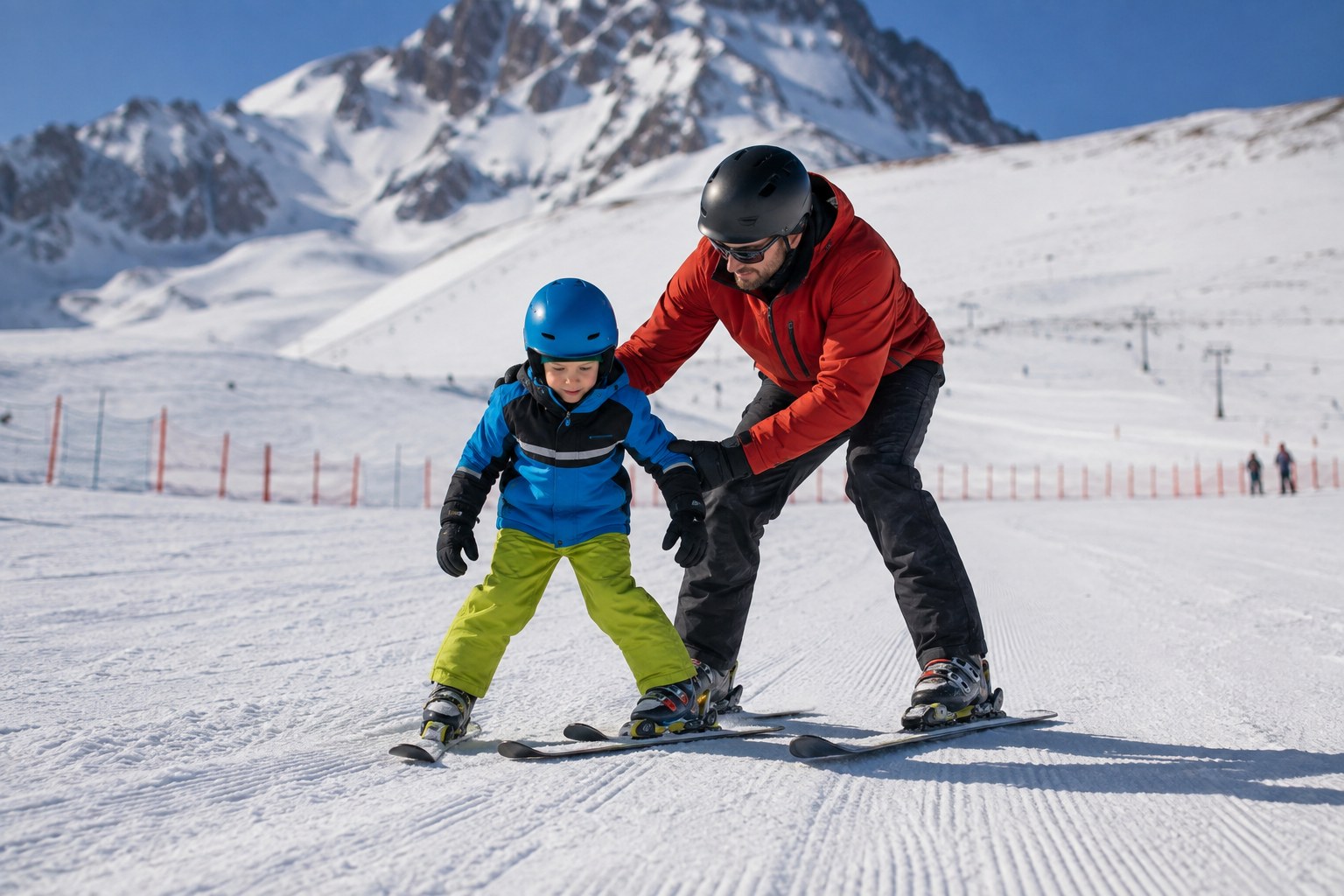
One of the questions that families who will come to Erciyes Ski Center with their children are most curious about is “At what age should children start learning to ski?”. There is no single strict age limit for learning to ski. The child’s physical development, balance, ability to understand instructions, adaptation to cold weather conditions and willingness to ski are as important as the child’s age.
In general, around the age of 3-4, children can meet snow and do short, play-based skiing exercises in suitable conditions. More planned and technical ski training may become more efficient at later ages, depending on the child’s development. The goal here is not for the child to slide as early and fast as possible; It introduces snow, ski equipment and basic movements in a safe and fun way.
At What Age Can Children Start Learning to Ski?
Since children’s developmental levels are different from each other, it is not right to make a decision based only on calendar age. Of two children of the same age, one may be comfortable in ski boots, while the other may need more time to get used to the equipment or the cold environment.
For many children, approximately 4 years of age and beyond may be a suitable period to start basic ski training. For younger children, playing on the snow, getting used to the equipment, short walks and simple balance exercises can be emphasized rather than long technical lessons.
Can 3-4 Year Old Children Learn to Ski?
Some 3-4 year old children can begin to get acquainted with skiing. However, the aim in this age group should not be long and intense technical training as in adults. It is more important for the child to get used to the ski boots, to balance on the snow, and to see skiing as a fun activity.
Short-term and game-based studies may be preferred. When the child gets tired or loses interest, a break should be given instead of forcing the lesson to continue.
Studies that can be done in the 3-4 age group
- Walking in a safe area with ski boots,
- Getting to know ski equipment,
- Doing simple balance exercises with one ski,
- Performing short slides on very low slope areas,
- Learning to bend the knees slightly and basic posture,
- Improving balance and coordination through games.
At these ages, lesson duration and content should be adjusted according to the child’s attention span. While some children adapt to the environment in a short time, for some, just having fun on the snow is enough for the first day.
Is 4-6 Years Suitable for Learning to Ski?
Between the ages of 4 and 6, children’s balance, coordination and instruction-following skills continue to develop. For this reason, basic ski techniques can be practiced more regularly with a training program appropriate for their age and development.
During this period, the ski instructor can teach the child technical terms by showing and gamifying the movements rather than explaining them in detail. Movements such as basic stance, slowing down, stopping and changing direction left and right can be practiced gradually according to the child’s level.
Basic Techniques That Can Be Learned at This Age
- Attaching and removing skis correctly,
- Learning basic ski stance,
- Stable sliding on low slope,
- Getting into the snow plow position,
- Reducing speed and stopping under control,
- Making basic turns left and right.
Is It Easier to Learn to Ski After the Age of 7?
Attention span, balance, coordination and the ability to understand technical instructions given by the instructor are generally more developed in school-age children. For this reason, basic ski movements can be practiced more systematically.
However, starting after the age of 7 does not mean “being late”. Children and adults can start skiing at different ages. The important thing is that the person receives education appropriate to his level.
As the skiing technique improves, one can move from snow plowing to connected turns, then to more advanced movements such as parallel skiing depending on the level.
What is more important than age to learn skiing?
Age alone is not enough when assessing whether a child is ready for ski lessons. Families and educators need to monitor the child’s physical and emotional readiness together.
Can the Child Follow Simple Directions?
During ski training, short instructions such as “stop”, “wait”, “bend your knees”, “come here” must be understood. It is important for learning and safety that the child can follow basic instructions.
Is Balance and Coordination Sufficient?
While skiing, the feet, knees, hips and body must move together. If the child is comfortable with normal walking, running and simple balancing movements, it can make the process of learning to ski easier.
Perfect balance is not expected in the first lesson. One of the purposes of ski training is to improve the child’s balance and coordination on skis.
Does the Child Want to Ski?
The child’s willingness to learn skiing is one of the most important elements of the education process. Forcing a child who is afraid to ski or does not want to attend class that day can be counterproductive.
Making the first experience fun may make the child more enthusiastic about the next ski days. For more information on reducing fear in children You can review our guide overcoming the fear of skiing in children.
Can It Adapt to Cold Weather and Equipment?
Ski boots are harder than casual shoes. Helmets, goggles, gloves and layered ski clothing may also feel different for the child at first.
Before the first ski lesson, getting the child to know the equipment and moving around in ski boots for a short time can help the child feel more comfortable when he gets on the piste.
What is Taught in a Child’s First Ski Lesson?
The content of the first ski lesson varies depending on the child’s age, level and whether he or she has previous skiing experience. The aim of a child skiing for the first time is not to go directly to a high slope.
Training usually begins with basic equipment use and balance exercises on a safe, low-incline starting area.
Getting to Know Ski Equipment
The purpose of ski boots, skis, bindings, helmet and other basic equipment is explained to the child in a simple way. How to put on and take off the skis can be demonstrated in practice.
Learning to Walk on Skis
Making small movements with skis on a low slope or flat area helps the child get used to the long equipment on his feet.
The goal in this section is not speed; Being able to move comfortably on skis.
Basic Ski Stance
Slightly bending the knees, keeping the body balanced and not leaning back excessively are parts of the basic ski stance.
It is often more understandable for children to have the instructor demonstrate the movement and have the child imitate it, rather than long technical explanations.
Slowing Down and Stopping in Skiing
It is important that the child learns how to slow down and stop before speeding up. At the beginning level, speed control can be worked on by using the snow plow position.
It is not right to take a child to sloped tracks before the ability to stop in a controlled manner has developed.
Basic Right and Left Turns
Once the child starts to control his speed, large and simple right-left turns can be practiced. Connecting turns is an important stage in the development of ski mastery.
How Long Should a Children’s First Ski Lesson Last?
The ideal lesson time for children may vary depending on age, attention span, weather conditions and physical endurance. For this reason, it is not correct to determine a single lesson duration valid for every child.
Especially for young children, short and productive studies may be more appropriate than long periods of uninterrupted education. A break should be given when the child starts to get tired, cold or lose focus.
Lesson time is limited to “how many hours did he ski?” Rather than evaluating it as:, it is more important how much the child enjoys it and what basic skills he learns during that time.
Private Ski Lessons or Group Lessons for Children?
Both types of education may have different advantages. For very young children who will be skiing for the first time, one-on-one instruction can allow the instructor to adjust all their attention to the child’s level and needs.
For older children who enjoy social learning, small groups created at an appropriate level can be fun. However, it is important that the levels of the children in the group are close to each other.
| Educational Type | Featured Feature |
|---|---|
| Private Ski Lesson | One-to-one progress according to the child’s speed and level |
| Group Ski Lesson | Social and fun learning with children at similar levels |
How Should a Child Dress for Ski Lessons?
Children need to be able to stay warm and move comfortably while skiing. Instead of clothes that are too thick and restrict movement, layered clothing suitable for weather conditions can be preferred.
Essential Items That Can Be Found in Children’s Ski Clothes
- Thermal inner layer,
- Ski jacket,
- Ski trousers,
- Suitable ski socks,
- Gloves suitable for water and cold,
- Neck protection,
- Ski helmet,
- Snow goggles.
The child’s sweating can affect comfort as much as his/her coldness. Therefore, it is advantageous to be able to adjust the layers according to the air temperature.
Why Are Ski Helmets Important for Children?
It is important for children to use a helmet of the correct size and suitable for skiing when skiing and snowboarding. The helmet should not move more than necessary on the head and the chin strap should be adjusted correctly.
As the child grows older, it should not be assumed that the helmet from the previous season is still the correct size. The compatibility of the equipment should be re-checked before use each season.
How to Choose Ski Boots for a Child?
It is not right to choose ski boots that are too big for your child with the thought that “their feet will grow anyway”. If the foot moves excessively in the boot, ski control may become difficult.
The boot should fit the child’s foot evenly, but should not cause pressure, pain or numbness. In rental equipment, the child’s actual foot size and ski level must be accurately reported to the staff.
Should Children Use Poles While Skiing?
For young children who are just starting their ski training, the instructor may prefer to work without using a baton at the first stage. This way, the child can focus primarily on balancing on his feet, knees and skis.
As the technique improves, batons can be used according to level and training program. For this reason, it should not be thought that baton must be used for the first lesson.
Should the Child Ride the Chairlift on the First Day?
Not every child needs to get on the chair lift right away on their first day of skiing. It may not be right to move on to longer tracks before the basic balance, stopping and direction changing movements are sufficiently developed in the starting area.
A treadmill or mechanical facilities suitable for the starting area can make it easier to repeat basic movements. The use of the chairlift can be taught in later stages depending on the child’s level and the instructor’s evaluation.
What Should Families Pay Attention to When Their Child is Learning to Ski?
- Do not compare the child with other children.
- Do not pressure him to learn faster.
- Do not try to make it hard on the first day.
- Let him take a break when he gets tired.
- Check regularly to see if it is cold.
- Ensure that he/she uses a ski helmet and appropriate equipment.
- Associate ski training with play and fun.
- Support the process instead of interfering with the instructions given by the instructor.
What to Do If a Child is Afraid of Skiing?
Ski boots, long skis, cold weather and a sloped track may be unfamiliar to a young child at first encounter. For this reason, it is normal for some children to be shy at first.
Instead of forcibly sending the child down the slope, it is necessary to first make him feel comfortable with the equipment and the snow. Games, short slides and simple accomplishments on a low slope can support self-confidence.
Instead of saying “Don’t be afraid, nothing will happen”, taking small steps that the child can control creates a healthier learning environment.
When can a child switch to the Blue Track?
The child’s age alone is not a criterion for passage to the blue track. Basic ski control should be sufficient.
If the child can slow down, stop, turn left and right in a controlled manner and follow the instructions of the instructor, a blue track suitable for his/her level can be considered.
For general safety rules on the track, you can review our guide things to consider on ski and snowboard tracks.
Why Do Children Learn to Ski Differently?
While one child may start doing basic turns on the first day, another child may reach the same stage after a few lessons. This does not mean that one is more talented or unsuccessful than the other.
Balance, sports history, physical development, attention span, self-confidence and interest in skiing can affect the speed of learning.
For this reason, the goal in children’s ski training is not to advance to an advanced level as soon as possible, but to ensure that basic skills develop correctly.
Do Children Forget Skiing Technique?
The balance and movement patterns learned during skiing improve with regular repetition. When a season is stopped, young children may need to remember the basic movements again, especially in the first days.
On the first ski day of the new season, it is useful to repeat the basic stops, decelerations and turns on a few easy tracks, instead of going directly to the most difficult track of the previous season.
The Basis of Safe Ski Training for Children
In children’s ski training, safety should not be considered separately from technical development. It is important that the child is on a track suitable for his/her level, uses the correct equipment, wears a helmet and skates under adult supervision.
Children should not be left on the track alone, and especially younger children should be under the supervision of an adult or instructor.
First Ski Lesson for Children in Erciyes
At Erciyes Ski Center, children’s first ski training can start in low-slope areas suitable for their level. In the first stage, movements such as using equipment, moving with skis, basic stance, balance, snow plowing, slowing down and stopping can be studied.
As the child’s confidence and technical control develop, right-left turns, connected turns and track exercises appropriate to his level can be added to the training program.
You can review our page Erciyes ski lesson to get information about the training program suitable for your child’s level.
Ski Training for Children with Legendary Veysel Hodja
At Erciyes Ski Center with Legendary Veysel Hodja, appropriate ski training can be planned, taking into account the children’s age, ski experience and current level. The aim for children who will ski for the first time is to provide a safe, controlled and enjoyable start to skiing.
Training can be progressed gradually, from the basic ski stance to the snow plow, from slowing down and stopping to right-left turns. As the child’s level improves, more advanced ski techniques can be used.
Ski Instructor – Legendary Veysel Hodja
Erciyes Ski Resort – Kayseri
Phone / WhatsApp: +90 532 355 08 13